Titanic replicas
See also: Replica Titanic and Titanic II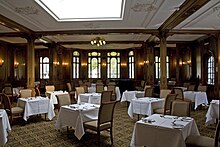 There have been several proposals and studies for a project to build a replica ship based on the Titanic. A project by South African businessman Sarel Gaus was abandoned in 2006, and a project by Australian businessman Clive Palmer was announced in 2012, known as the Titanic II.First Class Lounge of the Olympic which was almost identical to that of the Titanic, seen today as a dining room in the White Swan Hotel, Alnwick
A Chinese shipbuilding company known as Wuchang Shipbuilding Industry Group Co.,Ltd commenced construction in January 2014 to build a replica ship of the Titanic for use in a resort. The vessel will house many features of the original, such as a ballroom, dining hall, theatre, first-class cabins, economy cabins and swimming pool.[271][272] Tourists will be able to reside inside the Titanic during their time at the resort. It will be permanently docked at the resort and feature an audiovisual simulation of the sinking, which has caused some criticism.[273]
The RMS Olympic was the sister ship of the Titanic. The interior decoration of the dining salon and the grand staircase were in identical style and created by the same craftsmen. Large parts of the interior of the Olympic were later sold and are now in the White Swan Hotel, Alnwick, which gives an impression of how the interior of the Titanic looked.
See also
- International Maritime Organization
- Lists of shipwrecks
- RMS Titanic alternative theories, alternative explanations for the fate of the Titanic (rather than it hitting an iceberg)
- Futility, or the Wreck of the Titan
- Audio tape interview by Lyle Bebensee of the last male survivor of the sinking of the Titanic, Bill Muller.

Notes
- Carlisle would leave the project in 1910, before the ships were launched, when he became a shareholder in Welin Davit & Engineering Company Ltd, the firm making the ship's davits.[12] Wilding was sacked following the Titanic disaster, having apparently been blamed by Pirrie, unfairly, for the ship's loss.[13]
- It was kept off-limits to passengers; the famous "flying" scene at the ship's bow from the 1997 film Titanic would not have been permitted in real life.
- This photo is probably of Titanic's sister ship, Olympic.[26]
- Copy after Merry-Joseph Blondel of the neoclassical oil painting[57]
- Measurement of lifeboats: 1–2: 25'2" long by 7'2" wide by 3'2" deep; 326.6 cubic feet (9.25 m3); 3–16: 30' long by 9'1" wide by 4' deep; 655.2 cubic feet (18.55 m3) and A–D: 27'5" long by 8' wide by 3' deep; 376.6 cubic feet (10.66 m3)
- Since 1894, when the largest passenger ship under consideration was the Cunard Line's 13,000-ton Lucania, the Board of Trade had made no provision to increase the existing scale regarding the number of required lifeboats for larger ships, such as the 46,000-ton Titanic. Sir Alfred Chalmers, nautical adviser to the Board of Trade from 1896 to 1911, had considered the matter of adjusting the scale "from time to time", but because he not only assumed that experienced sailors would need to be carried "uselessly" aboard ship only to lower and man the extra lifeboats, but also anticipated the difficulty in getting away a greater number than 16 boats in any emergency, he "did not consider it necessary to increase [the scale]".[65]
- He expressed deep disappointment about the decision before the voyage, but was presumably greatly relieved afterwards.[99]
- Titanic also had a ship's cat, Jenny, who gave birth to a litter of kittens shortly before the ship's maiden voyage; all perished in the sinking.[103]
- Known afterward as the "Unsinkable Molly Brown" due to her efforts in helping other passengers while the ship sank
- Captain Edward Smith had been in command of Titanic's sister Olympic when she in 1911 collided with a warship. Even though that ship was designed to sink others by ramming them, it suffered greater damage than Olympic, thereby strengthening the image of the class being unsinkable.[138][139]
- The official enquiry found that damage extended about 300 feet, but both Edward Wilding's testimony and modern ultrasound surveys of the wreck suggest the total area was perhaps a few narrow openings totalling perhaps no more than 12 to 13 square feet (1.1 to 1.2 m2).[142][72]
- An incident confirmed this philosophy while Titanic was under construction: the White Star liner Republic was involved in a collision and sank. Even though she did not have enough lifeboats for all passengers, they were all saved because the ship was able to stay afloat long enough for them to be ferried to ships coming to assist.[145]
- Life expectancy in such temperatures is often under 15 minutes even for people who are young and fit. The victims would have died from bodily reactions to freezing water rather than hypothermia (loss of core temperature). Immersed into freezing seas, around 20% of victims die within two minutes from cold shock (uncontrolled rapid breathing and gasping causing water inhalation, massive increase in blood pressure, cardiac strain leading to cardiac arrest, and panic), another 50% die within 15–30 minutes from cold incapacitation (inability to use or control limbs and hands for swimming or gripping, as the body 'protectively' shuts down peripheral muscles to protect its core),[152] and exhaustion and unconsciousness cause drowning, claiming the rest within a similar time.[153]
- The Salvation Army newspaper, The War Cry, reported that "none but a heart of stone would be unmoved in the presence of such anguish. Night and day that crowd of pale, anxious faces had been waiting patiently for the news that did not come. Nearly every one in the crowd had lost a relative."[169] It was not until 17 April that the first incomplete lists of survivors came through, delayed by poor communications.[170]
- On 23 April, the Daily Mail reported: "Late in the afternoon hope died out. The waiting crowds thinned, and silent men and women sought their homes. In the humbler homes of Southampton there is scarcely a family who has not lost a relative or friend. Children returning from school appreciated something of tragedy, and woeful little faces were turned to the darkened, fatherless homes."[177]
- According to an eyewitness report, there "were many pathetic scenes" when Titanic's survivors disembarked at New York[citation needed]
- Lord protested his innocence to the end of his life, and many researchers have asserted that the known positions of Titanic and Californian make it impossible that the former was the infamous "mystery ship", a topic which has "generated ... millions of words and ... hours of heated debates" and continues to do so.[203]
- Most of the bodies were numbered, however, the five passengers buried at sea by Carpathia went unnumbered.[214]
- Thomas Beattie, a first class passenger, and two crew members, a fireman and a seaman.
- An example is Daniel Butler's book about RMS Titanic, titled Unsinkable
- Ship's time; at the time of the collision, Titanic's clocks were set to 2 hours 2 minutes ahead of Eastern Time Zone and 2 hours 58 minutes behind Greenwich Mean Time.[269]
- Beveridge & Hall 2004, p. 1.
- "Titanic Ship Listing". Chris' Cunard Page. Archived from the original on 15 April 2012. Retrieved 12 April 2012.
- Second Officer Lightoller insisted on excluding men, while First Officer Murdoch, on the other side of the ship, permitted men and women to board the lifeboats.
- "Patrick S. Ryan, The ITU and the Internet's Titanic Moment" (PDF). Retrieved 2014-07-04.
- Chirnside 2004, p. 319.
- Beveridge & Hall 2011, p. 27.
- Bartlett 2011, p. 26.
- "Outgoing Steamships – Sail Saturday October 26, 1912: Majestic (Southampton)". The Sun. October 24, 1912. Retrieved 18 May 2015.
- Bartlett 2011, p. 25.
- Hutchings & de Kerbrech 2011, p. 12.
- Hutchings & de Kerbrech 2011, p. 14.
- "Testimony of Alexander Carlisle". British Wreck Commissioner's Inquiry. 30 July 1912. Retrieved 8 November 2008.
- McCluskie 1998, p. 20.
- Eaton & Haas 1995, p. 55.
- Eaton & Haas 1995, p. 56.
- McCluskie 1998, p. 22.
- Chirnside 2004, p. efn319.
- Hutchings & de Kerbrech 2011, p. 47.
- Gill 2010, p. 229.
- Hutchings & de Kerbrech 2011, p. 48.
- Gill 2010, p. 232.
- Gill 2010, p. 233.
- Gill 2010, p. 235.
- Gill 2010, p. 236.
- Gill 2010, p. 237.
- Beveridge 2008, p. 100.
- Gill 2010, p. 120.
- Gill 2010, p. 121.
- Hutchings & de Kerbrech 2011, p. 79.
- Hutchings & de Kerbrech 2011, p. 80.
- Gill 2010, p. 126.
- Gill 2010, p. 148.
- Hutchings & de Kerbrech 2011, p. 86.
- Hutchings & de Kerbrech 2011, p. 85.
- Hutchings & de Kerbrech 2011, p. 96.
- Gill 2010, p. 127.
- Hutchings & de Kerbrech 2011, p. 74.
- Hutchings & de Kerbrech 2011, p. 106.
- Hutchings & de Kerbrech 2011, p. 107.
- Hutchings & de Kerbrech 2011, p. 44.
- Gill 2010, p. 104.
- Hutchings & de Kerbrech 2011, p. 68.
- Hutchings & de Kerbrech 2011, p. 70.
- Gill 2010, p. 162.
- Bruce Beveridge et al., edited by Art Braunschweiger (2008). Titanic : the ship magnificent (3rd ed.). Stroud, Gloucestershire: History Press. ISBN 0752446061.
- Gill 2010, p. 165.
- Hutchings & de Kerbrech 2011, p. 57.
- Gill 2010, p. 182.
- https://www.encyclopedia-titanica.org/titanic-victim/gaspare-antonio-pietro-gatti.html
- "1st Class Cafe Parisien". National Museums Northern Ireland. 2011. Retrieved 28 May 2011.
- Brewster, Hugh & Coulter, Laurie. 882 1/2 Answers to Your Questions About The Titanic, Scholastic Press, 1998; 32.
- Gill 2010, p. 189.
- Hutchings & de Kerbrech 2011, p. 59.
- Lynch 1992, p. 53.
- Lynch 1992, p. 207.
- Merideth 2003, p. 236.
- New York Times, Thursday January 16th, 1913, Titanic Survivors Asking $6,000,000, p.28
- Gill 2010, p. 146.
- Eaton & Haas 1987, p. 131.
- The Titanic: The Memorabilia Collection, by Michael Swift, Igloo Publishing 2011, ISBN 978-0-85780-251-4
- Hutchings & de Kerbrech 2011, p. 112.
- Lord 1997, p. 78.
- Chirnside 2004, p. 26.
- Butler 1998, p. 38.
- "Board of Trade's Administration". British Wreck Commissioner's Inquiry. 30 July 1912. Retrieved 9 November 2008.
- Berg, Chris (13 April 2012). "The Real Reason for the Tragedy of the Titanic". The Wall Street Journal.
- Gill 2010, p. 78.
- Hutchings & de Kerbrech 2011, p. 42.
- Hutchings & de Kerbrech 2011, p. 43.
- Gill 2010, p. 87.
- Felkins, Leighly & Jankovic 1998.
- Broad 1997.
- Materials Today, 2008.
- McCarty & Foecke 2012, p. [page needed].
- Broad 2008.
- Verhoeven 2007, p. 49.
- Smith, Jonathan. "Titanic: The Hingley Anchors".
- Gill 2010, p. 105.
- Gill 2010, p. 109.
Saturday, April 8, 2017
Appendix


Legacy
Safety

An ice patrol aircraft inspecting an iceberg
Further, the United States government passed the Radio Act of 1912. This act, along with the International Convention for the Safety of Life at Sea, stated that radio communications on passenger ships would be operated 24 hours a day, along with a secondary power supply, so as not to miss distress calls. Also, the Radio Act of 1912 required ships to maintain contact with vessels in their vicinity as well as coastal onshore radio stations.[241] In addition, it was agreed in the International Convention for the Safety of Life at Sea that the firing of red rockets from a ship must be interpreted as a sign of need for help. Once the Radio Act of 1912 was passed it was agreed that rockets at sea would be interpreted as distress signals only, thus removing any possible misinterpretation from other ships.[241]
Finally, the disaster led to the formation and international funding of the International Ice Patrol, an agency of the United States Coast Guard that to the present day monitors and reports on the location of North Atlantic Ocean icebergs that could pose a threat to transatlantic sea traffic. Coast Guard aircraft conduct the primary reconnaissance. In addition, information is collected from ships operating in or passing through the ice area. Except for the years of the two World Wars, the International Ice Patrol has worked each season since 1913. During the period there has not been a single reported loss of life or property due to collision with an iceberg in the patrol area.[242] In 1912, the Board of Trade chartered the barque Scotia to act as a weather ship in the Grand Banks of Newfoundland, keeping a look-out for icebergs. A Marconi wireless was installed to enable her to communicate with stations on the coast of Labrador and Newfoundland.[243][244]
Cultural
Main article: Cultural legacy of RMS Titanic

Titanic Belfast, 2012
The first film about the disaster, Saved from the Titanic, was released only 29 days after the ship sank and had an actual survivor as its star—the silent film actress Dorothy Gibson.[250] The British film A Night to Remember (1958) is still widely regarded as the most historically accurate movie portrayal of the sinking.[251] The most financially successful by far has been James Cameron's Titanic (1997), which became the highest-grossing film in history up to that time,[252] as well as the winner of 11 Oscars at the 70th Academy Awards, including Best Picture and Best Director for Cameron.[253]
The Titanic disaster was commemorated through a variety of memorials and monuments to the victims, erected in several English-speaking countries and in particular in cities that had suffered notable losses. These included Southampton, Liverpool and Belfast in the United Kingdom; New York and Washington, D.C. in the United States; and Cobh (formerly Queenstown) in Ireland.[254] A number of museums around the world have displays on Titanic. In Northern Ireland, the ship is commemorated by the Titanic Belfast visitor attraction, opened on 31 March 2012, that stands on the site of the shipyard where Titanic was built.[255]
RMS Titanic Inc., which is authorised to salvage the wreck site, has a permanent Titanic exhibition at the Luxor Las Vegas hotel and casino in Nevada which features a 22-ton slab of the ship's hull. It also runs an exhibition which travels around the world.[256] In Nova Scotia, Halifax's Maritime Museum of the Atlantic displays items that were recovered from the sea a few days after the disaster. They include pieces of woodwork such as panelling from the ship's First Class Lounge and an original deckchair,[257] as well as objects removed from the victims.[258] In 2012 the centenary was marked by plays, radio programmes, parades, exhibitions and special trips to the site of the sinking together with commemorative stamps and coins.[167][259][260][261][262]
In a frequently commented-on literary coincidence, Morgan Robertson authored a novel called Futility in 1898 about a fictional British passenger liner with the plot bearing a number of similarities to the Titanic disaster. In the novel the ship is the SS Titan, a four-stacked liner, the largest in the world and considered unsinkable. But like the Titanic, she sinks on her maiden[verification needed] voyage after hitting an iceberg and does not have enough lifeboats.[263]
Wreck
Main article: Wreck of the RMS Titanic

The bow of the wrecked RMS Titanic, photographed in June 2004
The team discovered that Titanic had in fact split apart, probably near or at the surface, before sinking to the seabed. The separated bow and stern sections lie about a third of a mile (0.6 km) apart in Titanic Canyon off the coast of Newfoundland. They are located 13.2 miles (21.2 km) from the inaccurate coordinates given by Titanic's radio operators on the night of her sinking,[225] and approximately 715 miles (1,151 km) from Halifax and 1,250 miles (2,012 km) from New York.
Both sections struck the sea bed at considerable speed, causing the bow to crumple and the stern to collapse entirely. The bow is by far the more intact section and still contains some surprisingly intact interiors. In contrast, the stern is completely wrecked; its decks have pancaked down on top of each other and much of the hull plating was torn off and lies scattered across the sea floor. The much greater level of damage to the stern is probably due to structural damage incurred during the sinking. Thus weakened, the remainder of the stern was flattened by the impact with the sea bed.[226]
The two sections are surrounded by a debris field measuring approximately 5 by 3 miles (8.0 km × 4.8 km).[227] It contains hundreds of thousands of items, such as pieces of the ship, furniture, dinnerware and personal items, which fell from the ship as she sank or were ejected when the bow and stern impacted on the sea floor.[228] The debris field was also the last resting place of a number of Titanic's victims. Most of the bodies and clothes were consumed by sea creatures and bacteria, leaving pairs of shoes and boots—which have proved to be inedible—as the only sign that bodies once lay there.[229]
Since its initial discovery, the wreck of Titanic has been revisited on numerous occasions by explorers, scientists, filmmakers, tourists and salvagers, who have recovered thousands of items from the debris field for conservation and public display. The ship's condition has deteriorated significantly over the years, particularly from accidental damage by submersibles but mostly because of an accelerating rate of growth of iron-eating bacteria on the hull.[230] It has been estimated that within the next 50 years the hull and structure of Titanic will eventually collapse entirely, leaving only the more durable interior fittings of the ship intermingled with a pile of rust on the sea floor.[231]

Bell from the Titanic
On 16 April 2012, the day after the 100th anniversary of the sinking, photos were released showing possible human remains resting on the ocean floor. The photos, taken by Robert Ballard during an expedition led by NOAA in 2004, show a boot and a coat close to Titanic's stern which experts called "compelling evidence" that it is the spot where somebody came to rest, and that human remains could be buried in the sediment beneath them.[234] The wreck of the Titanic falls under the scope of the 2001 UNESCO Convention on the Protection of the Underwater Cultural Heritage. This means that all states party to the convention will prohibit the pillaging, commercial exploitation, sale and dispersion of the wreck and its artefacts. Because of the location of the wreck in international waters and the lack of any exclusive jurisdiction over the wreckage area, the convention provides a state co-operation system, by which states inform each other of any potential activity concerning ancient shipwreck sites, like the Titanic, and co-operate to prevent unscientific or unethical interventions.[235][236][237]
Survivors and victims
Main article: List of Titanic passengers
The number of casualties of the sinking is unclear, due to a number
of factors. These include confusion over the passenger list, which
included some names of people who cancelled their trip at the last
minute, and the fact that several passengers travelled under aliases for
various reasons and were therefore double-counted on the casualty
lists.[204] The death toll has been put at between 1,490 and 1,635 people.[205] The tables below use figures from the British Board of Trade report on the disaster.[95]Fewer than a third of those aboard Titanic survived the disaster. Some survivors died shortly afterwards; injuries and the effects of exposure caused the deaths of several of those brought aboard Carpathia.[206] The figures show stark differences in the survival rates of the different classes aboard Titanic. Although only 3% of first-class women were lost, 54% of those in third class died. Similarly, five of six first-class and all second-class children survived, but 52 of the 79 in third class perished. The differences by gender were even bigger: nearly all female crew members, first and second class passengers were saved. Men from the First Class died at a higher rate than women from the Third Class.[207] In total, 50% of the children survived, 20% of the men and 75% of the women.
The last living survivor, Millvina Dean from England, who at only nine weeks old was the youngest passenger on board, died aged 97 on 31 May 2009.[208] A special survivor was crew member Violet Jessop who survived the sinkings of both Titanic and Britannic and was aboard Olympic when she was rammed in 1911.[209]
| Age/ |
Class/ |
Number aboard | Number saved | Number lost | Percentage saved | Percentage lost |
|---|---|---|---|---|---|---|
| Children | First Class | 6 | 5 | 1 | 83% | 17% |
| Second Class | 24 | 24 | 0 | 100% | 0% | |
| Third Class | 79 | 27 | 52 | 34% | 66% | |
| Women | First Class | 144 | 140 | 4 | 97% | 3% |
| Second Class | 93 | 80 | 13 | 86% | 14% | |
| Third Class | 165 | 76 | 89 | 46% | 54% | |
| Crew | 23 | 20 | 3 | 87% | 13% | |
| Men | First Class | 175 | 57 | 118 | 33% | 67% |
| Second Class | 168 | 14 | 154 | 8% | 92% | |
| Third Class | 462 | 75 | 387 | 16% | 84% | |
| Crew | 885 | 192 | 693 | 22% | 78% | |
| Total | 2224 | 710 | 1514 | 32% | 68% | |
Retrieval and burial of the dead

Markers of Titanic victims, Fairview Cemetery, Halifax, Nova Scotia
The first ship to reach the site of the sinking, the CS Mackay-Bennett, found so many bodies that the embalming supplies aboard were quickly exhausted. Health regulations required that only embalmed bodies could be returned to port.[215] Captain Larnder of the Mackay-Bennett and undertakers aboard decided to preserve only the bodies of first class passengers, justifying their decision by the need to visually identify wealthy men to resolve any disputes over large estates. As a result, many third class passengers and crew were buried at sea. Larnder identified many of those buried at sea as crew members by their clothing, and stated that as a mariner, he himself would be contented to be buried at sea.[216]
Bodies recovered were preserved for transport to Halifax, the closest city to the sinking with direct rail and steamship connections. The Halifax coroner, John Henry Barnstead, developed a detailed system to identify bodies and safeguard personal possessions. Relatives from across North America came to identify and claim bodies. A large temporary morgue was set up in the curling rink of the Mayflower Curling Club and undertakers were called in from all across eastern Canada to assist.[216] Some bodies were shipped to be buried in their home towns across North America and Europe. About two-thirds of the bodies were identified. Unidentified victims were buried with simple numbers based on the order in which their bodies were discovered. The majority of recovered victims, 150 bodies, were buried in three Halifax cemeteries, the largest being Fairview Lawn Cemetery followed by the nearby Mount Olivet and Baron de Hirsch cemeteries.[217]
In mid-May 1912, RMS Oceanic recovered three bodies over 200 miles (320 km) from the site of the sinking who were among the original occupants of Collapsible A. When Fifth Officer Harold Lowe and six crewmen returned to the wreck site sometime after the sinking in a lifeboat to pick up survivors, they rescued a dozen males and one female from Collapsible A, but left the dead bodies of three of its occupants.[s] After their retrieval from Collapsible A by Oceanic, the bodies were buried at sea.[218]
The last Titanic body recovered was steward James McGrady, Body No. 330, found by the chartered Newfoundland sealing vessel Algerine on 22 May and buried at Fairview Lawn Cemetery in Halifax on 12 June.[219]
Only 333 bodies of Titanic victims were recovered, one in five of the over 1500 victims. Some bodies sank with the ship while currents quickly dispersed bodies and wreckage across hundreds of miles making them difficult to recover. By June one of the last search ships reported that life jackets supporting bodies were coming apart and releasing bodies to sink.[220]
Role of the SS Californian
One of the most controversial issues examined by the inquiries was the role played by SS Californian, which had been only a few miles from Titanic but had not picked up her distress calls or responded to her signal rockets. Californian had warned Titanic by radio of the pack ice that was the reason Californian had stopped for the night, but was rebuked by Titanic's senior wireless operator, Jack Phillips.[197]
Testimony before the British inquiry revealed that at 10:10 p.m., Californian observed the lights of a ship to the south; it was later agreed between Captain Stanley Lord and Third Officer C.V. Groves (who had relieved Lord of duty at 11:10 p.m.) that this was a passenger liner.[197] At 11:50 p.m., the officer had watched that ship's lights flash out, as if she had shut down or turned sharply, and that the port light was now visible.[197] Morse light signals to the ship, upon Lord's order, were made between 11:30 p.m. and 1:00 a.m., but were not acknowledged.[198] If Titanic were as far from the Californian as Lord claimed, then he knew, or should have known, that Morse signals would not be visible. A reasonable and prudent course of action would have been to awaken the wireless operator and to instruct him to attempt to contact Titanic by that method. Had Lord done so, it is possible he could have reached Titanic in time to save additional lives.[66]
Captain Lord had gone to the chartroom at 11:00 p.m. to spend the night;[199] however, Second Officer Herbert Stone, now on duty, notified Lord at 1:10 a.m. that the ship had fired five rockets. Lord wanted to know if they were company signals, that is, coloured flares used for identification. Stone said that he did not know and that the rockets were all white. Captain Lord instructed the crew to continue to signal the other vessel with the Morse lamp, and went back to sleep. Three more rockets were observed at 1:50 a.m. and Stone noted that the ship looked strange in the water, as if she were listing. At 2:15 a.m., Lord was notified that the ship could no longer be seen. Lord asked again if the lights had had any colours in them, and he was informed that they were all white.[200]
Californian eventually responded. At around 5:30 a.m., Chief Officer George Stewart awakened wireless operator Cyril Furmstone Evans, informed him that rockets had been seen during the night, and asked that he try to communicate with any ship. He got news of Titanic's loss, Captain Lord was notified, and the ship set out to render assistance. She arrived well after Carpathia had already picked up all the survivors.[201]
The inquiries found that the ship seen by Californian was in fact Titanic and that it would have been possible for Californian to come to her rescue; therefore, Captain Lord had acted improperly in failing to do so.[202][q]
Testimony before the British inquiry revealed that at 10:10 p.m., Californian observed the lights of a ship to the south; it was later agreed between Captain Stanley Lord and Third Officer C.V. Groves (who had relieved Lord of duty at 11:10 p.m.) that this was a passenger liner.[197] At 11:50 p.m., the officer had watched that ship's lights flash out, as if she had shut down or turned sharply, and that the port light was now visible.[197] Morse light signals to the ship, upon Lord's order, were made between 11:30 p.m. and 1:00 a.m., but were not acknowledged.[198] If Titanic were as far from the Californian as Lord claimed, then he knew, or should have known, that Morse signals would not be visible. A reasonable and prudent course of action would have been to awaken the wireless operator and to instruct him to attempt to contact Titanic by that method. Had Lord done so, it is possible he could have reached Titanic in time to save additional lives.[66]
Captain Lord had gone to the chartroom at 11:00 p.m. to spend the night;[199] however, Second Officer Herbert Stone, now on duty, notified Lord at 1:10 a.m. that the ship had fired five rockets. Lord wanted to know if they were company signals, that is, coloured flares used for identification. Stone said that he did not know and that the rockets were all white. Captain Lord instructed the crew to continue to signal the other vessel with the Morse lamp, and went back to sleep. Three more rockets were observed at 1:50 a.m. and Stone noted that the ship looked strange in the water, as if she were listing. At 2:15 a.m., Lord was notified that the ship could no longer be seen. Lord asked again if the lights had had any colours in them, and he was informed that they were all white.[200]
Californian eventually responded. At around 5:30 a.m., Chief Officer George Stewart awakened wireless operator Cyril Furmstone Evans, informed him that rockets had been seen during the night, and asked that he try to communicate with any ship. He got news of Titanic's loss, Captain Lord was notified, and the ship set out to render assistance. She arrived well after Carpathia had already picked up all the survivors.[201]
The inquiries found that the ship seen by Californian was in fact Titanic and that it would have been possible for Californian to come to her rescue; therefore, Captain Lord had acted improperly in failing to do so.[202][q]
Insurance and aid for survivors
In January 1912, the hulls and equipment of Titanic and Olympic had been insured through Lloyd's of London.
The total coverage was £1,000,000 (£89,289,575 today) per ship. The
policy was to be "free from all average" under £150,000, meaning that
the insurers would only pay for damage in excess of that sum. The
premium, negotiated by brokers Willis Faber & Company (now Willis Group), was 15 s (75 p)
per £100, or £7,500 (£669,672 today) for the term of one year. Lloyd's
paid the White Star Line the full sum owed to them within 30 days.[178]
Many charities were set up to help the victims and their families, many of whom lost their sole breadwinner, or, in the case of many Third Class survivors, everything they owned. On 29 April opera stars Enrico Caruso and Mary Garden and members of the Metropolitan Opera raised $12,000 ($292,682.93 in 2014)[179] in benefits for victims of the disaster by giving special concerts in which versions of "Autumn" and "Nearer My God To Thee" were part of the programme.[180] In Britain, relief funds were organised for the families of Titanic's lost crew members, raising nearly £450,000 (£40,180,309 today). One such fund was still in operation as late as the 1960s.[181]
The US Senate's inquiry into the disaster was initiated on 19 April, a day after Carpathia arrived in New York.[183] The chairman, Senator William Alden Smith, wanted to gather accounts from passengers and crew while the events were still fresh in their minds. Smith also needed to subpoena all surviving British passengers and crew while they were still on American soil, which prevented them from returning to the UK before the American inquiry was completed on 25 May.[184] The British press condemned Smith as an opportunist, insensitively forcing an inquiry as a means of gaining political prestige and seizing "his moment to stand on the world stage". Smith, however, already had a reputation as a campaigner for safety on US railroads, and wanted to investigate any possible malpractices by railroad tycoon J. P. Morgan, Titanic's ultimate owner.[185]
The British Board of Trade's inquiry into the disaster was headed by Lord Mersey, and took place between 2 May and 3 July. Being run by the Board of Trade, who had previously approved the ship, it was seen by some as having little interest in its own or White Star's conduct being found negligent.[186]
Each inquiry took testimony from both passengers and crew of Titanic, crew members of Leyland Line's Californian, Captain Arthur Rostron of Carpathia and other experts.[187] The British inquiry also took far greater expert testimony, making it the longest and most detailed court of inquiry in British history up to that time.[188] The two inquiries reached broadly similar conclusions: the regulations on the number of lifeboats that ships had to carry were out of date and inadequate,[189] Captain Smith had failed to take proper heed of ice warnings,[190] the lifeboats had not been properly filled or crewed, and the collision was the direct result of steaming into a dangerous area at too high a speed.[189]
Neither inquiry's findings listed negligence by IMM or the White Star Line as a factor. The American inquiry concluded that since those involved had followed standard practice the disaster was an act of God.[191] The British inquiry concluded that Smith had followed long-standing practice that had not previously been shown to be unsafe,[192] noting that British ships alone had carried 3.5 million passengers over the previous decade with the loss of just 10 lives,[193] and concluded that Smith had done "only that which other skilled men would have done in the same position". The British inquiry also warned that "what was a mistake in the case of the Titanic would without doubt be negligence in any similar case in the future".[192]
The recommendations included strong suggestions for major changes in maritime regulations to implement new safety measures, such as ensuring that more lifeboats were provided, that lifeboat drills were properly carried out and that wireless equipment on passenger ships was manned around the clock.[194] An International Ice Patrol was set up to monitor the presence of icebergs in the North Atlantic, and maritime safety regulations were harmonised internationally through the International Convention for the Safety of Life at Sea; both measures are still in force today.[195]
On 18 June 1912, Guglielmo Marconi gave evidence to the Court of Inquiry regarding the telegraphy. Its final report recommended that all liners carry the system and that sufficient operators maintain a constant service.[196]
Many charities were set up to help the victims and their families, many of whom lost their sole breadwinner, or, in the case of many Third Class survivors, everything they owned. On 29 April opera stars Enrico Caruso and Mary Garden and members of the Metropolitan Opera raised $12,000 ($292,682.93 in 2014)[179] in benefits for victims of the disaster by giving special concerts in which versions of "Autumn" and "Nearer My God To Thee" were part of the programme.[180] In Britain, relief funds were organised for the families of Titanic's lost crew members, raising nearly £450,000 (£40,180,309 today). One such fund was still in operation as late as the 1960s.[181]
Investigations into the disaster
Main articles: United States Senate inquiry into the sinking of the RMS Titanic and British Wreck Commissioner's inquiry into the sinking of the RMS Titanic
Even before the survivors arrived in New York, investigations were
being planned to discover what had happened, and what could be done to
prevent a recurrence. Inquiries were held in both the United States and
United Kingdom, the former more robustly critical of traditions and
practices, and scathing of the failures involved, and the latter broadly
more technical and expert-oriented.[182]The US Senate's inquiry into the disaster was initiated on 19 April, a day after Carpathia arrived in New York.[183] The chairman, Senator William Alden Smith, wanted to gather accounts from passengers and crew while the events were still fresh in their minds. Smith also needed to subpoena all surviving British passengers and crew while they were still on American soil, which prevented them from returning to the UK before the American inquiry was completed on 25 May.[184] The British press condemned Smith as an opportunist, insensitively forcing an inquiry as a means of gaining political prestige and seizing "his moment to stand on the world stage". Smith, however, already had a reputation as a campaigner for safety on US railroads, and wanted to investigate any possible malpractices by railroad tycoon J. P. Morgan, Titanic's ultimate owner.[185]
The British Board of Trade's inquiry into the disaster was headed by Lord Mersey, and took place between 2 May and 3 July. Being run by the Board of Trade, who had previously approved the ship, it was seen by some as having little interest in its own or White Star's conduct being found negligent.[186]
Each inquiry took testimony from both passengers and crew of Titanic, crew members of Leyland Line's Californian, Captain Arthur Rostron of Carpathia and other experts.[187] The British inquiry also took far greater expert testimony, making it the longest and most detailed court of inquiry in British history up to that time.[188] The two inquiries reached broadly similar conclusions: the regulations on the number of lifeboats that ships had to carry were out of date and inadequate,[189] Captain Smith had failed to take proper heed of ice warnings,[190] the lifeboats had not been properly filled or crewed, and the collision was the direct result of steaming into a dangerous area at too high a speed.[189]
Neither inquiry's findings listed negligence by IMM or the White Star Line as a factor. The American inquiry concluded that since those involved had followed standard practice the disaster was an act of God.[191] The British inquiry concluded that Smith had followed long-standing practice that had not previously been shown to be unsafe,[192] noting that British ships alone had carried 3.5 million passengers over the previous decade with the loss of just 10 lives,[193] and concluded that Smith had done "only that which other skilled men would have done in the same position". The British inquiry also warned that "what was a mistake in the case of the Titanic would without doubt be negligence in any similar case in the future".[192]
The recommendations included strong suggestions for major changes in maritime regulations to implement new safety measures, such as ensuring that more lifeboats were provided, that lifeboat drills were properly carried out and that wireless equipment on passenger ships was manned around the clock.[194] An International Ice Patrol was set up to monitor the presence of icebergs in the North Atlantic, and maritime safety regulations were harmonised internationally through the International Convention for the Safety of Life at Sea; both measures are still in force today.[195]
On 18 June 1912, Guglielmo Marconi gave evidence to the Court of Inquiry regarding the telegraphy. Its final report recommended that all liners carry the system and that sufficient operators maintain a constant service.[196]
Subscribe to:
Comments (Atom)